Tuesday, March 02, 2010

Visual Studies Department Exhibition Celebrates Collaborative Creative Processes / 嶺南大學舉辦「憑空而來」畫展


Lingnan University’s Department of Visual Studies has organized a one-month painting exhibition, titled Out of Thin Air – collaborative and solo work, which opened on 27 February 2010. The artworks showcased in the exhibition are by Assistant Professor Dr Carol Archer, and produced either individually or in collaboration with artist-partners. The works in the exhibition are selected from two ongoing series, Reciprocal Interference and Time with the Sky.

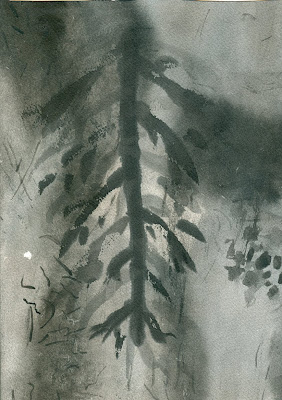
The Reciprocal Interference series comprises collaborative artworks by Dr Archer and five artist-friends: Ms Sue Rawlinson, Ms Sue Taylor, Ms Johanna Trainor (Australia), Ms Mary Grehan (Ireland) and Ms Even Mak (Hong Kong). Reciprocal Interference works-in-progress were airmailed between collaborating partners in Hong Kong, Macao, Australia and Ireland. The most recent phase of the project includes a series of postcard-works by Ms Taylor and Dr Archer. The Time with the Sky series of charcoal and watercolour drawings were begun during Dr Archer’s residency in Australia in 2009. They were inspired by the big Australian sky and the eucalypts that stretch up toward it. Solo works, these drawings are destined to contribute to a cross-disciplinary collaboration with poet Dr Christopher (Kit) Kelen.
“But the exhibition title Out of Thin Air is also ironically intended,” Archer comments, “because seemingly unpredictable aspects of the two series are in fact the result of sustained thought, effort and dialogue, as well as conducive circumstances.”

Dr Archer has been teaching in the Visual Studies Department at Lingnan University since 2007. She has shown her work in twelve solo exhibitions and over 30 group exhibitions held in Australia, Japan, Italy, China, Hong Kong and Macao.

Out of Thin Air – collaborative and solo work will be shown in Sun Yat Sen University, Guangzhou from 30 April – 13 May 2010 as part of the Visual Studies Department’s ‘travelling exhibitions’ initiative funded by the Lingnan Foundation.


嶺南大學舉辦「憑空而來」畫展

嶺南大學(嶺大)視覺研究系將於2月27日舉辦助理教授區勵志博士的個人及合作畫展:「憑空而來」。是次畫展為期一個月,展出的作品來自區博士兩個仍在進行中的創作系列,包括她與五位友人合作的「互涉」及個人創作的「與天共度的時光」。
「互涉」是區博士與5位藝術家友人包括Sue Rawlinson女士、Sue Taylor女士、Johanna Trainor女士(澳洲)、Mary Grehan女士(愛爾蘭)及 Even Mak女士(香港) 正在進行的合作系列,這系列的作品涉及五位藝術家在香港、澳門、澳洲及愛爾蘭之間的郵遞互傳。是次展出的是區博士與Taylor 合作的名信片作品。
「與天共度的時光」則是區氏2009年在澳洲居住期間創作的炭筆及水彩繪畫,靈感源自澳洲廣闊的天空及伸展向天空的桉樹。系列是為畫家與詩人Christopher Kelen將會合作的跨媒介創作的一個嘗試,畫作可獨立來看,亦可與詩人的詩一起閱讀。
區博士說:「畫展的題目 - 憑空而來 – 卻是諷刺的特意點題,兩個系列的創作過程以乎無法預計,卻是持續不斷的思巧、努力及對話的成果。」
區博士2007年加入嶺大視覺研究系任教,曾舉辦過十二個個人展及參與逾30個聯展,作品曾在澳洲、日本、內地、香港及澳門展出。

嶺大視覺研究系「憑空而來」畫展由嶺南基金資助的,在嶺大校園展出後將於4月30日至5月13日巡迴至廣州中山大學展出。有關是次展覽的資料可瀏覽區博士的網誌http://carolarcher.blogspot.com/

Wednesday, January 06, 2010

Out of Thin Air – collaborative and solo work 憑空而來—個人及合作畫展


Out of Thin Air – collaborative and solo work
憑空而來—個人及合作畫展

Carol Archer 區勵志

Exhibition Opening:
Saturday 27 February, 3:30-5:30 pm

Exhibition dates:
27 Feb – 28 March, 2010
Lingnan University, Hong Kong

30 April – 13 May, 2010
Sun Yat Sen University, Guangzhou

Brief Description of the Exhibition:

The works in this exhibition are part of two larger series, both of which are ongoing; namely, the Reciprocal Interference/互涉 project and Time with the Sky/與天共度的時光. The Reciprocal Interference project consists of two-person collaborative works by Carol Archer and artist-friends Sue Rawlinson, Sue Taylor, Johanna Trainor (Australia), Mary Grehan (Ireland) and Even Mak (Hong Kong). The most recent phase of the Reciprocal Interference collaboration includes the production, by Taylor and Archer, of a series of postcard-works, which incorporate addresses, postmarks and stamps. The Time with the Sky series of charcoal and watercolour drawings was begun during Archer’s residency at Bundanon (Australia) in July 2009. Solo works, these pictures of sky framed by the uppermost branches of trees, are destined to contribute to a cross-disciplinary collaboration with poet Christopher (Kit) Kelen. Both series came out of thin air: Reciprocal Interference works-in-progress were airmailed between collaborating partners in Hong Kong, Macao, Australia and Ireland. The Time with the Sky works are inspired by the big Australian sky, and the eucalypts that stretch up toward it. But the exhibition title Out of Thin Air is also ironically intended, because seemingly unpredictable aspects of the two series are in fact the result of sustained thought, effort and dialogue, as well as conducive circumstances. Each series has evolved through conversations that take up questions artistic, literary and scholarly in nature. Out of Thin Air is an exhibition that foregrounds collaborative creative processes.

Wednesday, July 16, 2008

Reciprocal Interference: a collaborative art project by Carol Archer with Mary Grehan, Even Mak, Sue Rawlinson, Sue Taylor and Johanna Trainor


Catalogue

Picture 1
Reciprocal Interference: Mary Grehan and Carol Archer 1
, 2007
Collection of Janet Murchie


Picture 2
Reciprocal Interference: Sue Rawlinson and Carol Archer 1, 2006
Collection of Janet Donald


Picture 3
Reciprocal Interference: Even Mak and Carol Archer 1, 2008
Picture 4
Reciprocal Interference: Johanna Trainor and Carol Archer 1, 2008
Collection of Janet Murchie


Picture 5
Reciprocal Interference: Sue Taylor and Carol Archer 1, 2006


Picture 6
Reciprocal Interference: Sue Taylor and Carol Archer 2, 2006


Picture 7
Reciprocal Interference: Sue Rawlinson and Carol Archer 2, 2006
Collection of Janet Donald

Picture 8
Reciprocal Interference: Sue Rawlinson and Carol Archer 3, 2006
Picture 9
Reciprocal Interference: Johanna Trainor and Carol Archer 2, 2007
Collection of Terese and Jonti Lambourne


Picture 10
Reciprocal Interference: Sue Taylor and Carol Archer 3, 2007


Picture 11
Reciprocal Interference: Sue Rawlinson and Carol Archer 4, 2006
Collection of Johanna Trainor

Picture 12
Reciprocal Interference: Sue Rawlinson and Carol Archer 5, 2006


Picture 13
Reciprocal Interference: Mary Grehan and Carol Archer 2, 2007
Picture 14
Reciprocal Interference: Sue Rawlinson and Carol Archer 6, 2006

Picture 15
Reciprocal Interference: Sue Rawlinson and Carol Archer 7, 2006


Picture 16
Reciprocal Interference: Mary Grehan and Carol Archer 3, 2008


Picture 17
Reciprocal Interference: Even Mak and Carol Archer 2, 2008


Picture 18
Reciprocal Interference: Mary Grehan and Carol Archer 4, 2007
Picture 19
Reciprocal Interference: Sue Taylor and Carol Archer 4, 2006


Picture 20
Reciprocal Interference: Sue Taylor and Carol Archer 5, 2007


Picture 21
Reciprocal Interference: Even Mak and Carol Archer 3, 2008


Picture 22
Reciprocal Interference: Sue Taylor and Carol Archer 6, 2006
Collection: Magdaline Shenton-Kaleido


Picture 23
Reciprocal Interference: Sue Rawlinson and Carol Archer 8, 2006

Picture 24
Reciprocal Interference: Sue Taylor and Carol Archer 7, 2006


Picture 25
Reciprocal Interference: Sue Rawlinson and Carol Archer 9, 2006


Picture 26
Reciprocal Interference: Johanna Trainor and Carol Archer 3, 2008


Picture 27
Reciprocal Interference: Johanna Trainor and Carol Archer 4, 2008


Picture 28
Reciprocal Interference: Mary Grehan and Carol Archer 5, 2007

Wednesday, June 04, 2008

Reciprocal Interference Project: Collaborations opens at Newcastle’s Podspace Gallery on Thursday 17 July, 2008.

Images from left to right: Carol Archer and Sue Rawlinson (mixed media on paper), Carol Archer and Mary Grehan(mixed media and moth's wing on paper), Carol Archer and Johanna Trainor (watercolour and photomedia), Carol Archer and Even Mak (acrylic on paper), Carol Archer and Sue Taylor (mixed media on paper) , all A4 sized. To look at the evolution of each collaboration, and works in various stages of their progress, go to www.rawlinsonarcher.blogspot.com, www.grehanarcher.blogspot.com, www.trainorarcher.blogspot.com, www.makarcher.blogspot.com, www.taylorarcher.blogspot.com

Reciprocal Interference Project: Collaborations opens at Newcastle’s Podspace Gallery on Thursday 17 July, 2008. Each piece in the exhibition is by Hong Kong-based artist Carol Archer and one other artist: Sue Rawlinson (Bondi), Sue Taylor (Canberra), Johanna Trainor (Newcastle), Mary Grehan (Ireland), Even Mak (Hong Kong). The first of these collaborations began in 2005, the others in 2006. Packages of works-in-progress have been bouncing back and forth ever since. No written instructions or descriptions arrive with the pictures – the conversation proceeds by means of the visual language in the works.

Reciprocal Interference? The phrase comes from Henri Bergson’s essay on laughter. When “two altogether independent series of events” come together, it may generate a comic effect, “the precise formula of which is very difficult to disentangle, by reason of the extraordinary variety of forms in which it appears”. Like the ingredients of a good joke, the works in the Reciprocal Interference Project are extremely diverse and could not have been predicted by their makers. Two artistic sensibilities meet in each work. Each picture results from a challenge posed by one artist and an answering visual intervention by the other. Process is important: these pictures could not have come into existence in any other way. A series of blogs, each highlighting the work-in-progress of a particular collaboration forms the virtual component of the project. Specific blog addresses are listed to the right of your screen.

The exhibition ends on Saturday 2 August.

Sunday, April 20, 2008

5 collaborations, 5 works


Sue Taylor and Carol Archer, 2007,
mixed media on paper, 30 x 21 cm


Johanna Trainor and Carol Archer
photomedia, 30 x 21 cm, 2008


Suzanne Rawlinson and Carol Archer,
mixed media on paper, 30 x 21 cm, 2005


Mary Grehan and Carol Archer, 2007
mixed media and moth's wing on paper,
30 x 21 cm


Even Mak and Carol Archer, 2006
mixed media on paper, 30 x 21 cm
You are warmly invited to the opening of
Reciprocal Interference Project – collaborative works on paper
by
Carol Archer (HK), Mary Grehan (Waterford, Ireland), Even Mak(HK), Sue Rawlinson (Sydney, Australia), Sue Taylor (Googong, Australia) and Johanna Trainor (Newcastle, Australia)
on
Thursday 17 July - 6-8pm
at
Podspace, 1st floor, 3/231 King St, Newcastle, NSW, Australia

Gallery opening times: Wednesday-Saturday 12pm – 5pm

Exhibition runs Wednesday 15 July until Saturday 1 August

Saturday, April 19, 2008

From Maria Lind, "The Collaborative Turn"

"Groups of artists, circles, associations, networks, constellations, partnerships, alliances, coalitions, contexts and teamwork- are all notions buzzing in the air of the artworld. However, cooperation in the art context is by no means new. On the contrary, its genealogy is long and complex, and includes a number of different formats for organising artistic work and its aesthetics. It extends from Rubens and other Baroque artists' hierarchical large-scale studios, which were lucrative businesses, to Surrealists' group experiments, constructivists' theatre projects, Fluxus games and Andy Warhol's pseudo-industrial Factory. It also has been argued that collaboration was crucial in the transition from Modernism to postmodernism, particularly since the advent of Conceptualism in the late 1960s. During the following decade, redefinitions of art tended to go hand in hand with collaborative practices." (16)

"Concepts like collaboration, cooperation, collective action, relationality and participation are used and often confused, although each of them has its own specific connotations. According to the collaboratively-compiled Wikipedia, however, collaboration can be described as follows: 'Collaboration refers abstractly to all processes wherein people work together- applying both to the work of individuals as well as larger collectives and societies. As an intrinsic aspect of human society, the term is used in many varying contexts such as science, art, education, and business.'
'Collaboration' is, as the above definition suggests, an open-ended concept, which in principle encompasses all the others. Collaboration becomes an umbrella term for the diverse working methods that require more than one participant. 'Cooperation', on the other hand, emphasises the notion of working together and mutually benefiting from it. Through its stress on solidarity, the word 'collective' gives an echo of working forms within a socialist social system. 'Collective action' refers precisely to acting together while 'interaction' can mean that several people interact with each other as well as that a single individual interacts with, for example, an apparatus by pressing a button. 'Participation' is more widely associated with the creation of a context in which particpants can take part in something that someone else has created but wherethere are, nevertheless, opportunities to have an impact" (17) .

"...But the result then? Does it make any differecne if diverse forms of artistic collaboration lie behind an artwork or another kind of cultural production? Is collaboration a 'better' method which produces 'better' results? The curatorial collective What, How and For Whom has a clear explanation for choosing collaboration as a method: the motivation to collaborate is that it would otherwise not take place;it simply has to make possible that which is otherwise impossible" (29).

Maria Lind, "The Collaborative Turn" in Johanna Billing, Maria Lind and Lars Nilsson (eds), Taking the Matter into Common Hands: On Contemporary Art and Collaborative Practices . London: Black Dog Publishing. 2007.

Wednesday, August 30, 2006

On the functions of literary collaborations between women

"Collaborative writing, at first glance, would support both these exceptions to professionalism, projecting alternatively an amateur practice (something done for amusement) and an expedient materialism (two can write more efficiently than one) ... Neither explanation, however, fully comprehends these partners’ literary investments. Even the Findlaters, who were reputedly so poor they had to write their first manuscripts on the back of grocers' paper and were in fact supporting themselves and their family by their pens, saw their writing as more than journeymen's labor. These were women, in other words, who did dream of counting themselves as professional authors. Collaboration, I want to argue, facilitated this dream by masking it. For under the guise of collaboration's evident amateurism, a number of women were able to slip into a professional position" ( Bette London, 1999, Writing Double: Women's Literary Partnerships, Ithaca and London: Cornell University Press, 104-105).

"If the literary culture at the turn of the century demanded a single author (if only the single author of individual parts) for writing to be deemed serious, what double writing inevitably achieved was to bring the work of writing into visibility. The very terms that governed public curiosity about these collaborations focused attention, in ways perhaps unprecedented, on the material of writing: on the hands of the author, the control of the pen, the possession of the page, not to mention the mechanics of character and plot construction, the components of a stylistic signature, the art of producing dialogue, the process of revision. Appearing at the very moment when popular writers' guides began to be codify these processes and procedures, literary collaborations could thus be read as a kind of living handbook to the art of fiction."
( Bette London, 1999, Writing Double: Women's Literary Partnerships, Ithaca and London: Cornell University Press, 107).

About the title of the project

The title of the project was inspired by a passage from Henri Bergon's book Laughter. Bergson writes:

"We have dwelt at considerable length on repetition and inversion; we now come to the reciprocal interference [Footnote: The word 'interference' has here the meaning given to it in Optics, where it indicates the partial superposition and neutralisation, by each other, of two series of light-waves.] of series. This is a comic effect, the precise formula of which is very difficult to disentangle, by reason of the extraordinary variety of forms in which it appears on the stage. Perhaps it might be defined as follows: A situation is invariably comic when it belongs simultaneously to two altogether independent series of events and is capable of being interpreted in two entirely different meanings at the same time." (an online version of Bergson's Laughter is
available at www.abacci.com , 55).

The notion of reciprocal interference seemed an apt way to title the project because it encompasses two important aspects of the collaborative artmaking process - reciprocity and struggle. While the collaborative artworks produced so far have sometimes been comic, and I have often laughed to see what I have received in a parcel from a fellow-collaborator, it is the "extraordinary variety of forms" that have emerged I have found particularly surprising and exciting. One's work is made strange by friends' interventions. It is fascinating to see how another artist deals with your work-in-process and the direction in which they take it. Because of those interventions, one becomes aware of entrenched habits - some examples in my case were a tendency to work in portrait format, to avoid figures, animals, narrative. It is invigorating to work in new ways, learning from and being challenged by one's friends. And it is scary - the more one admires a work the more one fears wrecking it. These collaborative practices entail putting aside such fears, resisting preciousness, and trusting that this risk-taking will generate good work, not every time perhaps, but often enough to make it worthwhile.